Costs for Value Provided
This is a great and important question! The financial industry seems to have a way of making costs and fees tricky to understand. Most people aren’t fully aware how they are being charged. Whether it’s from their bank account, an online firm, your 401(k), IRA, life insurance, an annuity, or their financial advisor. It gets overwhelming fast! Our goal here is to be upfront about how we’re compensated and make sure you feel confident and that you’re getting value for the service provided!
Forms of Compensation
We do receive compensation at Custer Financial Advisors believe it or not. We don’t think there is one solution that’s the right for everyone, so we allow clients to choose their preferred method based on what is right for them. Often after the first meeting we get a good sense of what may be the right fit for you.
Options 1: Advisory Fee Only
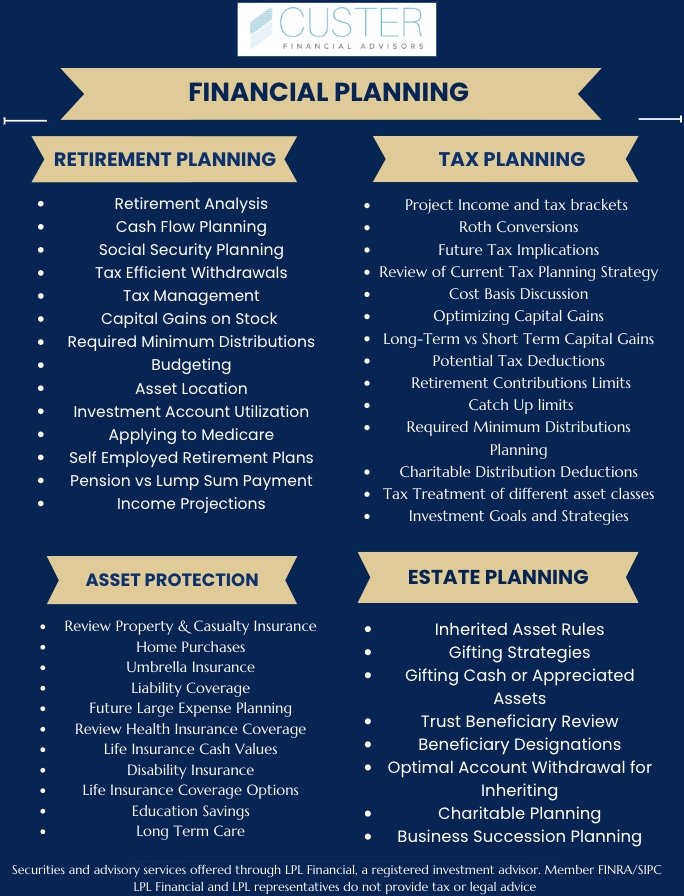
The fee only model includes everything that our flat fee planning covers and more. It includes review meetings regarding your financial plan. (see graphic below) We are not charging an additional fee with our advisory management. The fee is based on your assets under managements which includes our team of Certified Financial Planners™, Enrolled Agent and tax planner, investment research teams, and specialized portfolio managers who work together to invest and manage your assets. This model is typically a good fit for clients who want more than a one‑time financial plan and prefer to have professional teams manage their investments rather than handling it on their own.
Rather than being charged an upfront commission or flat fee, you’re charged a percentage of your assets. You will be charged this fee every year, which comes out of your account.
What People Like About the Asset Under Management Model:
You never wonder if we call, email, or have a meeting if it’s to charge you. We don’t charge for time.
We meet with clients for review conversations, and there’s no charge for those meetings. People appreciate being able to keep us updated as life changes. Because laws, taxes, markets—and your life—are always shifting, your plan should evolve too. Staying connected lets us adjust strategies early, which can help you avoid costly mistakes down the road.
The fee comes directly out of the investment account, so if it’s an IRA, you’re essentially paying it with pre‑tax dollars. It also means clients don’t have to come up with cash out of pocket to cover the flat fee.
People like the idea that if their account does better, we do better. If their account does worse, we receive less. This aims to help align our interests with yours, as we are both motivated to see your account grow.
People like that with the advisory account you’re not charged when we make changes to your investment portfolio. Because we’re an independent team, we can choose from a wide range of investment managers and strategies. This gives you access and flexibility allowing us to trade, adjust, and tap into different firms’ expertise without commissions for our clients.
The advisory account is considered a fiduciary account. A fiduciary financial planner means they are legally required to put your interests first. It means every recommendation is made with your goals in mind, not what pays the advisor more. (Note: As a CFP® we are always required to do this regardless of the account type)
Read the flat fee planning section too as everything we do with the flat fee planning we still include with our advisory services.
What people don’t like about the assets under management model:
The main negative to this style we think is that as your account grows, your fee can grow.
To help with this we do offer tiered billing which means as your accounts get to certain levels the percentage can go down. We have not raised the fee structure on clients once they become a client. Nor have we added charging for meetings like many highly skilled and specialized teams have. Often with flat planning fees the cost is increased over the years.
Option 2: Flat Fee Planning:
The asset under management model is widely the one most chosen, however, that doesn’t mean it’s the right fit for everyone! That’s why we also offer flat fee financial planning, which means your cost is not tied to assets under management. Instead, you pay a set fee for advice.
This option tends to work well for people who enjoy digging into financial planning, investment strategies, and tax planning on their own, but still want a professional to help spot blind spots and uncover potential opportunities they might miss. It’s similar to how some financial planners regularly meet with other specialists to learn, compare ideas, and sharpen their strategies.
Our goal with flat fee planning is simple: Make sure real value is being delivered, not just fluff meetings and reports. We want to make sure value is provided to your financial life. To do that, there does need to be a level of complexity involved.
A few example groups where this often fits.
Individuals 5–6 years from retirement or already retired but haven’t started Required Minimum Distributions (RMDs). This stage is where many pre‑retirees and retirees find the most value in professional guidance, especially around tax planning. It’s considered the retirement planning sweet spot because so many important decisions come together at once. Choices like which strategies may help reduce your tax bills in retirement, how to align your investments with your savings and spending goals, which accounts should hold certain investment strategies, whether Roth conversions make sense, how much to withdraw from each account (and in what order), when to claim Social Security, how to manage gains and losses and many more can all meaningfully affect how much you’re able to spend over time. It’s also a key window to make sure your plan stays sustainable and aims to avoid unnecessary costs like Medicare surcharges.
High earners: High earners often have more moving parts in their financial lives, which naturally makes planning more complex. Decisions around taxes, which accounts to use, how much to save in each, early‑retirement planning, tax‑efficient investing, stock‑based compensation, big purchases, and long‑term goals all start to overlap. Having a coordinated strategy becomes especially valuable as all these pieces interact.
Inheritances: Whether you’re trying to set up a plan for your kids in a tax‑efficient way or you’re the one receiving an inheritance and want to try and minimize how much goes to Uncle Sam, this is an area where trained guidance could make a big difference.
Doctors: Doctors often face a unique financial journey — years of student loans, low‑income intern, residency, and fellowship years, followed by a sudden jump to high earnings. Michael understands this world firsthand. His wife is a physician, and he has spent many hours studying and planning around the financial challenges doctors encounter — from choosing the right student loan repayment strategy to deciding which accounts to save in, building tax‑efficient investments, and more. Even as a CERTIFIED FINANCIAL PLANNER™ and Enrolled Agent, he quickly realized just how complex these situations can become.
How much are flat fee plans?
Pricing varies based on complexity and time involved. It could range anywhere from $2,000 to $10,000 for that project or yearly.
Option 3: Commission-Based Model
This is a lesser used model by our team. It used to be more widely used across the industry. With this model, if you purchase a mutual fund, or other investment, you are charged a commission. This commission goes to pay the investment fund company, the advisors, and the managers of your funds. Often for long-term investments, this is a one-time commission (which the industry calls an A-Share). The amount of commission charged by the fund company varies depending on the company and how much money you are investing with them. After you pay the one-time commission, you will pay a smaller annual fee (called a 12b1 fee), as part of the funds’ expense ratio.
What People like about the Front-Load Charge:
This could be the less expensive option if you are investing for the long term and you are willing to "buy and hold," meaning you don't want to make a many trades in your account to feel like you're being a good investor.
The more money you invest, the lower your commission percentage can be.
Downside of the Commission-Based (Front-Load) Model:
With the front-load charge we may be limited to what investments we use in your account. We typically like to stay with one fund company, so you don’t have to pay the front-load commission multiple times. Therefore, we are limited on the investment fund selections because we wouldn’t want to keep changing companies and incurring an additional commission on you! This is often referred to as “churning” an account.
As investment markets and teams change often, if we want to make a change to other teams you’d be facing potential commissions. Teams and investment companies change over the years. It can be tricky to change as commissions would be involved most likely.
What's the Best Option for Me?
This is a great question, and one our team has spent a lot of time thinking through. By the end of the first meeting, we usually have a good sense—together—of which option fits best based on what you’re looking for and the type of support you want.
We don’t believe there’s a one‑size‑fits‑all way to pay for financial planning. Just like the rest of your plan, the right approach depends on your situation, your goals, and how you prefer to work with a professional. Different clients value different things, and your fee structure should reflect that.
What matters most to us is that you understand your choices and feel confident selecting the option that makes the most sense for you. Our job is to help you make an informed decision—not to push you in a particular direction.
Disclosures:
*Securities and advisory services offered through LPL Financial, a Registered Investment Advisor, Member FINRA/SIPC.
The LPL Financial Registered Representatives associated with this site may only discuss and/or transact securities business with residents of the following states: MI.
LPL Financial and LPL representatives do not provide tax or legal advice.
All investing involves risk including loss of principal. No strategy assures success or protects against loss. Stock investing includes risks, including fluctuating prices and loss of principal. Investing in mutual funds involves risk, including possible loss of principal. Fund value will fluctuate with market conditions and it may not achieve its investment objective. Bonds are subject to market and interest rate risk if sold prior to maturity. Bond values will decline as interest rates rise and bonds are subject to availability and change in price. ETFs trade like stocks, are subject to investment risk, fluctuate in market value, and may trade at prices above or below the ETF's net asset value (NAV). Upon redemption, the value of fund shares may be worth more or less than their original cost. ETFs carry additional risks such as not being diversified, possible trading halts, and index tracking errors. Alternative investments may not be suitable for all investors and should be considered as an investment for the risk capital portion of the investor’s portfolio. The strategies employed in the management of alternative investments may accelerate the velocity of potential losses.